Masterface Attacks
Nine adversarial embeddings impersonate 47% of identities in a face verification model scoring 99.65% on benchmark — exposing the gap between pairwise accuracy and real security.
Pairwise Accuracy Is Not Security: Masterface Attacks Expose a Structural Vulnerability in Face Verification. Ehsan Nazari, 2026. GitHub · Technical report (PDF)
Face verification powers phone unlock, online ID checks, and border control. A model embeds each face as a vector and accepts a match when two embeddings fall within a threshold distance. Benchmarks like LFW report pairwise accuracy — does the system tell same-identity pairs from different-identity pairs? Modern systems score above 99% and feel solved.
This project shows the benchmark and the security guarantee are not the same thing. CosFace at 99.65% pairwise accuracy on LFW admits nine optimization-crafted embeddings that collectively impersonate 47.2% of LFW’s 5,749 identities — about 2,700 people, under the same threshold used for the accuracy headline. The pattern holds across ArcFace, AdaFace-IR101, AdaFace-ViT, and two FaceNet variants.
Method
The attack is two phases:
- Phase 1 — embedding-space search. Given a set of identity embeddings on the unit hypersphere, search for a point whose τ-neighborhood covers as many of them as possible. The non-differentiable max-coverage objective is replaced with a smooth surrogate and optimized with LM-MA-ES (1,000 generations, population 100). Identity sets are partitioned into 9 clusters via spherical k-means, matching the budget of prior masterface work.
- Phase 2 — image realization. Given a masterface embedding, iteratively perturb a source face in pixel space (Adam, PGD-style perturbation budget) so its embedding under the face mapper approaches the target. The result is a plausible-looking face whose embedding lies within τ of many unrelated identities. 88–97% of the Phase-1 coverage survives realization.
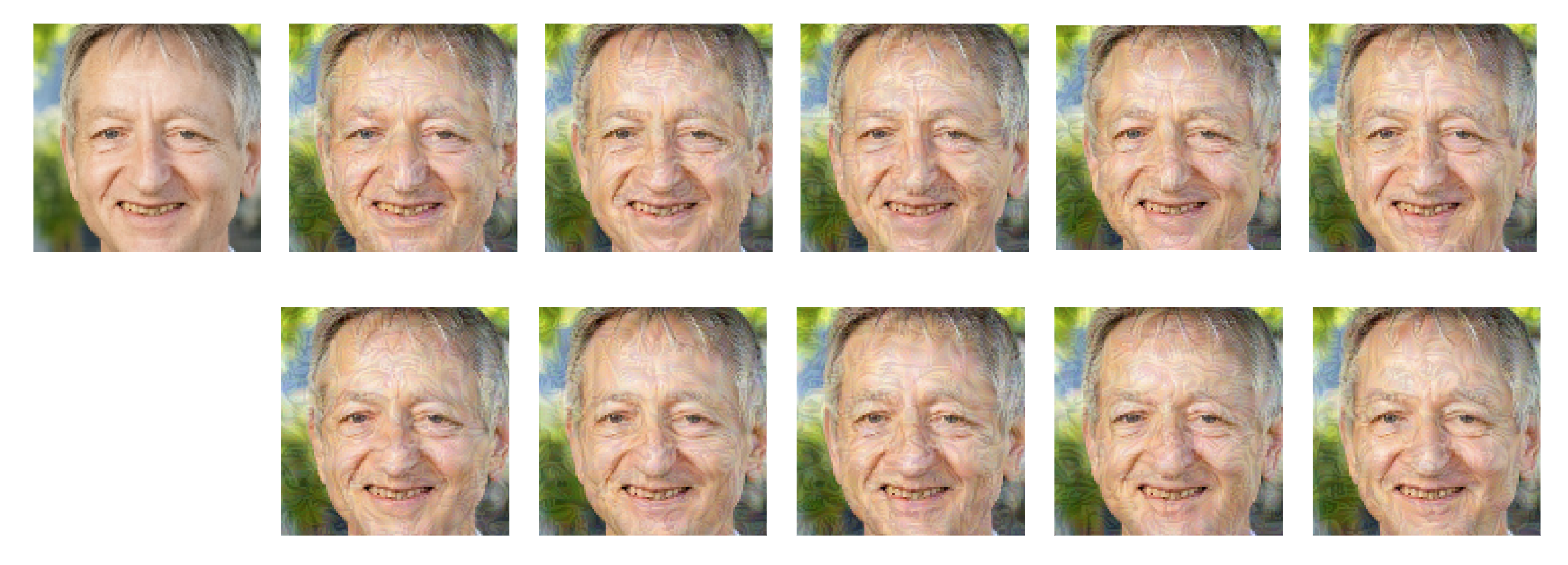
The Phase-2 result reaches 49.957% coverage on FaceNet-CASIA, surpassing the prior GAN-based result (Shmelkin et al., 2021, 43.82%) with a simpler, non-generative pipeline.
Two pipeline “footguns”
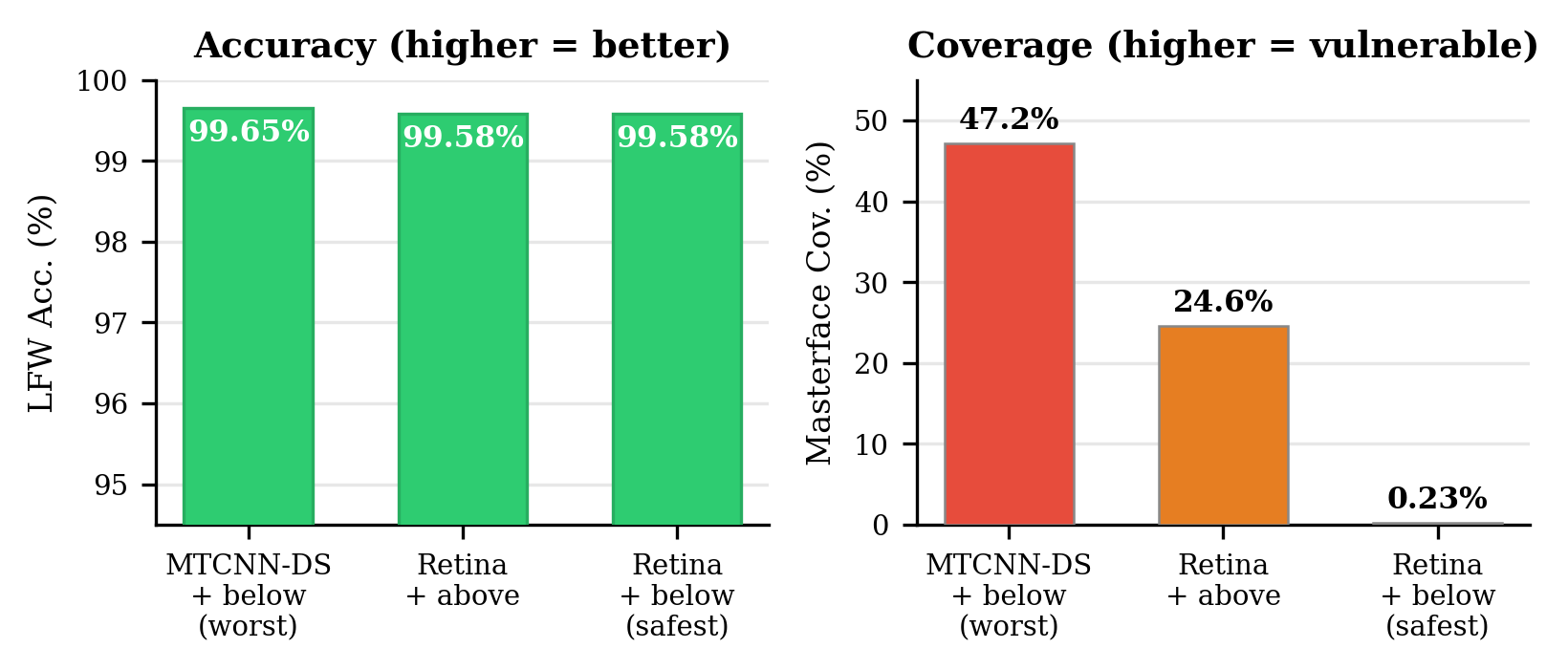
Identical model, identical dataset; two implementation choices change attack surface by up to two orders of magnitude while pairwise accuracy moves by ≤0.1 pp:
- FAR-threshold rounding direction — rounding the operating threshold toward stricter vs. looser FAR.
- Face-alignment strategy — MTCNN-DavidSandberg vs. RetinaFace alignment.
Both are security-critical, both are structurally invisible to the standard benchmark.
The irreducible floor (JT-Attack)
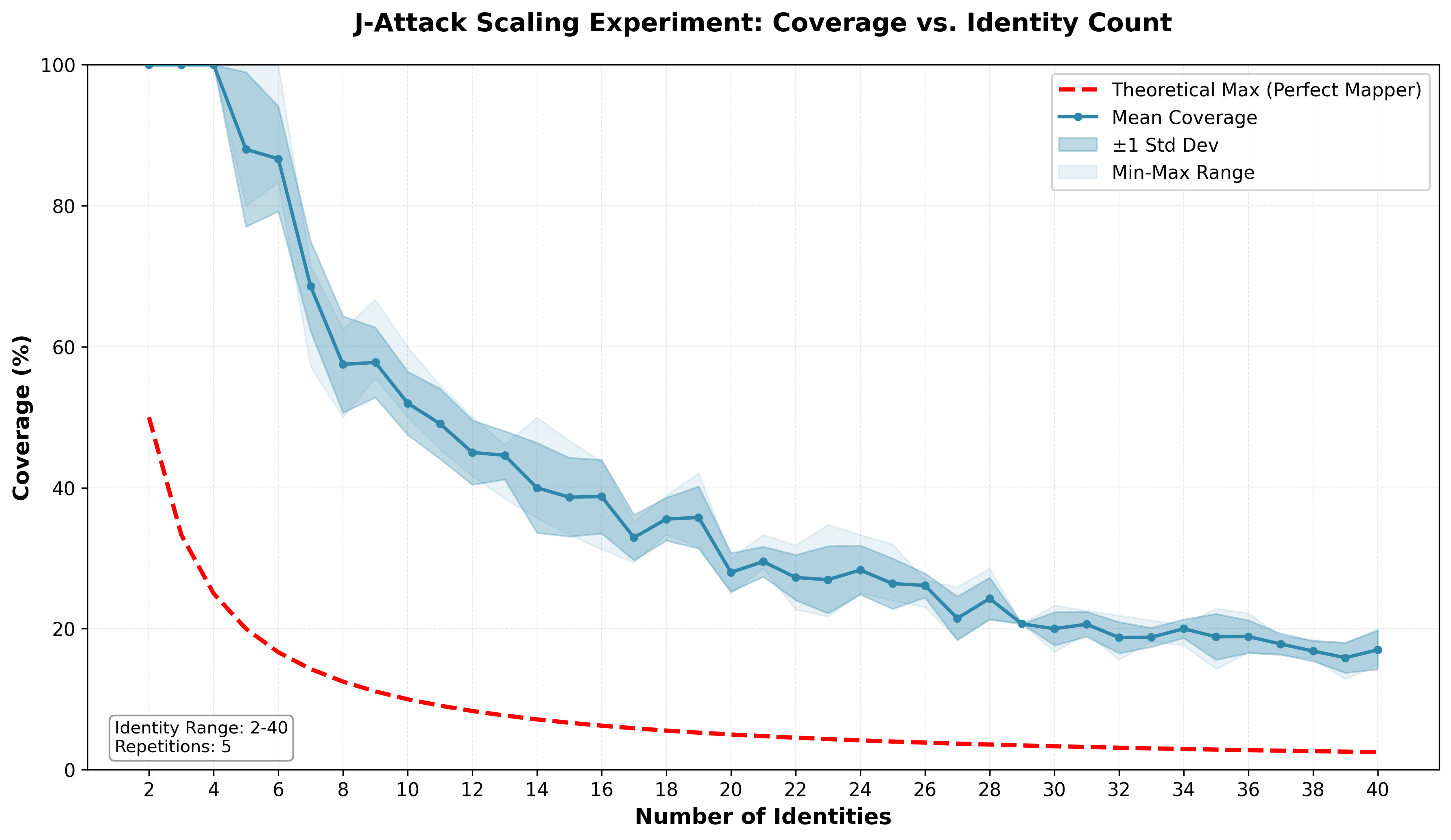
Under the safest pipeline configuration — the one where the broad masterface attack drops below 1% — a single embedding can still impersonate any 2–4 randomly chosen identities ~100% of the time, across every model tested. The theoretical maximum for a well-separated embedding space is 1/N; the observed curves blow past it. Pipeline mitigations bound the magnitude of broad attacks but leave targeted small-group attacks fully open. This is a model-level property, not an evaluation artifact.
Takeaway
Pairwise verification benchmarks were never designed to expose security vulnerabilities, and this work makes the gap concrete. The same six face-verification models, evaluated on the same identities, look uniformly excellent on the benchmark and vary wildly under attack. If a face verification deployment matters for security, the pairwise accuracy headline is not the right number to report.
Code, configs, and the full technical report are on GitHub.